Table Of Contents
- Which green card paths skip employer sponsorship?
- EB-1A: extraordinary ability
- EB-2 NIW: national interest waiver
- H-1B to green card: PERM vs. EB-1A vs. EB-2 NIW
- Can you keep your H-1B while you self-petition?
- How long does the H-1B to green card process take?
- What changed at USCIS in 2026?
- Working with Silicon Path Law
- Frequently Asked Questions (FAQs):
H-1B to Green Card: Why You Don’t Have to Wait for Employer Sponsorship
You can move from H-1B to green card without employer sponsorship if your record qualifies for EB-1A (extraordinary ability) or the EB-2 National Interest Waiver (NIW). In both categories you are the petitioner on Form I-140, so no employer has to file a PERM labor certification or the petition for you.
That matters if your employer has paused green card filings, if you plan to change jobs, or if you would rather not tie your future to one company’s timeline. A self-petition simply means you file the immigrant petition on your own behalf. Your H-1B employer still matters for your work status, but not for the petition itself.
This guide covers how each path works, how it fits with H-1B status, how long it takes, and what changed at USCIS in 2026.
Which green card paths skip employer sponsorship?
Two employment-based categories allow a self-petition: EB-1A and EB-2 NIW. Both still demand strong, well-documented evidence, and neither is a shortcut around USCIS review.
EB-1A: extraordinary ability
EB-1A is for people who have risen to the very top of their field and have sustained national or international acclaim. Under 8 CFR 204.5(h), you show either a one-time major, internationally recognized award or evidence that meets at least three of ten regulatory criteria.
The criteria include, for example, published material about you in major media, judging the work of others, original contributions of major significance, and a leading or critical role for a distinguished organization. Meeting three criteria is only the first step.
USCIS then makes a final merits determination. It weighs the whole record to decide whether you have sustained acclaim and stand at the top of your field. This two-step review comes from Kazarian v. USCIS, 596 F.3d 1115 (9th Cir. 2010), and is reflected in the USCIS Policy Manual.
EB-2 NIW: national interest waiver
The NIW waives the job offer and labor certification, but you must first qualify for EB-2 as an advanced-degree professional or a person of exceptional ability. USCIS then applies the three-part test from Matter of Dhanasar, 26 I&N Dec. 884 (AAO 2016):
- Your proposed endeavor has substantial merit and national importance.
- You are well positioned to advance it.
- On balance, the United States benefits from waiving the job offer and labor certification requirements.
NIW cases often turn on how clearly you define the proposed endeavor and how directly your track record supports it.
H-1B to green card: PERM vs. EB-1A vs. EB-2 NIW
The main difference is who controls the filing. In the PERM route your employer runs the process; in EB-1A and NIW, you do.
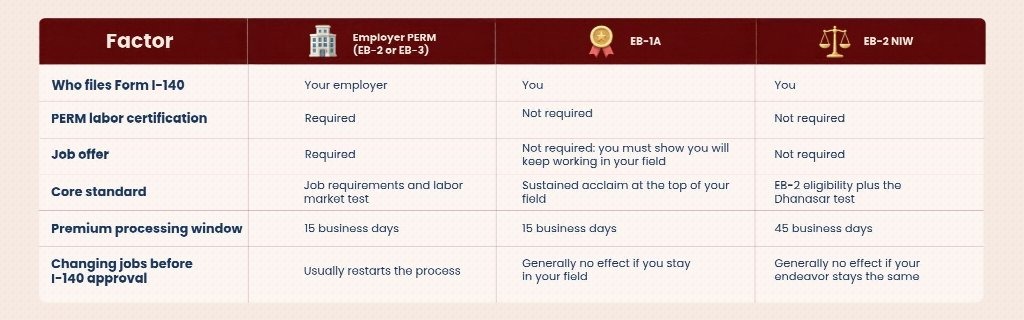
Premium processing buys a deadline for USCIS to act. That action can be an approval, a denial, a request for evidence (RFE), or a notice of intent to deny. The fee is $2,965 as of March 1, 2026, per USCIS.
Can you keep your H-1B while you self-petition?
Yes. H-1B is a dual intent status, so filing an immigrant petition does not by itself conflict with it You still need an H-1B employer to keep working in H-1B status, and the self-petition runs alongside it.
An approved self-petition can also help you stay past the six-year H-1B limit. Under AC21 section 104(c) and 8 CFR 214.2(h)(13)(i)(E), an H-1B worker with an approved EB-1, EB-2, or EB-3 petition who cannot get a green card because of per-country limits may extend in increments of up to three years.
The H-1B employer requesting that extension does not have to be the petitioner on the I-140. A pending or approved I-140 filed at least 365 days before you reach the six-year limit can also support one-year extensions under AC21 section 106(a). Eligibility turns on exact dates, so confirm the timing with counsel before you rely on it.
How long does the H-1B to green card process take?
Your country of birth drives most of the wait. Premium processing can produce an I-140 decision in weeks, but you cannot receive the green card until a visa number is available for your category and country.
The November 2026 Visa Bulletin, released October 22, 2026, shows the gap:
| Final action date (Nov 2026) | India | China | All other countries |
| EB-1 | Feb 1, 2023 | Aug 1, 2023 | Current |
| EB-2 | Nov 1, 2013 | Oct 1, 2021 | Apr 1, 2025 |
Source: U.S. Department of State Visa Bulletin. Dates change every month.
For many professionals born in India or China, this gap is why EB-1A gets a closer look. For November 2026, USCIS will accept employment-based adjustment applications under the Dates for Filing chart, so check the USCIS filing charts page each month.
Government fees for a self-petitioned Form I-140 are $715 by mail or $665 online, plus a $300 Asylum Program Fee, per the USCIS fee schedule (Form G-1055) as of October 2026.
What changed at USCIS in 2026?
Your first filing now needs to be your strongest. Under Policy Alert PA-2026-05, issued August 5, 2026, USCIS officers have more room to deny a petition without first issuing an RFE when the initial evidence does not show eligibility.
When an RFE is issued, the 12-week regulatory maximum is treated as a ceiling, and officers may set shorter deadlines. The legal standards for EB-1A and NIW did not change. What changed is how much room you have to fix a thin record after filing.
Working with Silicon Path Law
A pre-filing review by an immigration attorney is the most direct way to test whether your record fits EB-1A, NIW, or both. SiliconPath Law is an immigration law firm with a practice focused on employment-based petitions for technology professionals, researchers, and founders, including EB-1A, EB-2 NIW, and O-1 matters.
For an H-1B worker, that review typically looks at three questions. Which category does your evidence support today? How does the filing fit your H-1B extension timeline? Does filing EB-1A and NIW together make sense given your country of birth?
To discuss your situation, Contact SiliconPath Law through the firm’s website.
Frequently Asked Questions (FAQs):
No. You file EB-1A and NIW petitions yourself, and USCIS does not require employer consent. You still need your H-1B employer to maintain H-1B status, and some petitions include employer letters as evidence.
Yes. They are separate Form I-140 petitions, each with its own fees and evidence. Some people with a borderline EB-1A record file both to keep a fallback.
Often, yes. Under 8 CFR 204.5(e), a priority date from an approved I-140 generally carries over to a later I-140. The exceptions include revocation for fraud, willful misrepresentation, or material error, or invalidation of the labor certification.
No. It only guarantees that USCIS will act within 15 business days for EB-1A or 45 business days for NIW. The standard of review stays the same.
A denied I-140 does not by itself end your H-1B status, because H-1B allows immigrant intent. It can affect your options for extensions beyond six years, so plan the timing before you file.
Disclaimer: Attorney advertising..This article is general information, not legal advice, and reading it does not create an attorney-client relationship. Fees, policies, and Visa Bulletin dates change; figures here are current as of October, 2026. USCIS decides every petition on its own record, and prior results do not guarantee a similar outcome.